

The Preacher’s Son who Co-founded 2 Unicorns, now Building Fund for Africa’s Entrepreneurs
He co-founded Flutterwave and Andela. Now Iyin Aboyeji is building the Future Africa Fund to invest early in tech entrepreneurs and solve the continent’s challenges


For someone who co-founded two unicorns (privately held startup company valued at over $1 billion) in his home country, Iyinoluwa Aboyeji is one unassuming young man.
Popularly called ‘E”, his modesty, boisterous laughter and infectious personality could be disarming to an unexpected guest and most welcoming to a friend.
The 32-year-old tech entrepreneur and investor tells me his nickname ‘E’ stuck while he was schooling in Canada (University of Waterloo).
Everyone called him Junior or Samuel in primary and secondary school. But after his A-levels, he told his preacher dad that he would like to pick another name, to avoid confusing others, since his father’s name was also Samuel. So, he picked the less common one from his other two names – Iyinoluwa.
“When I got to Canada and told them my name was Iyinoluwa, the teacher couldn’t pronounce it. So, he started to call me ‘E’. That was how the name stuck.”
While some of his friends and family stayed back in Canada, Iyin decided to move back to Nigeria afterwards, in his words, to build the future.
In 2016, Iyin co-founded Flutterwave Inc- a global payments platform, two years after he resigned from Andela – a global talent network, which he also co-founded. Both have since become Unicorns and continue the carry the torch for Africa’s fintech revolution.
These feats have brought him global recognition as one of the most influential tech entrepreneurs. In 2019, the Forbes 30 under 30 honoree was named among the Top 100 most influential Africans by New African magazine.
“The biggest challenge with building those companies was that perhaps Flutterwave, more so than Andela, it seemed (at the time) impossible to build those businesses. To be very honest, at least for me, I never imagined it would be so big. I always thought, even when I left the businesses, I didn’t leave them as unicorns,” he recollects.
In some circles in his industry, some people still question Iyin’s reputation for “building two unicorns”. But he appears unfazed by those criticising his credentials or sometimes controversial views on social media.
People could assume things or make up stories, but “it’s very hard to debate fact,” he says matter-of-factly. “What people assume so that they can make themselves feel comfortable with whatever excuse they’ve made up about why they can’t be successful is really their business. Our job is to tell our story unvarnished as it is, in the hope that it inspires people, to also realize that in this country, it is possible.
“The fact is we work hard. The fact is we’re blessed by the grace of God. The fact is, we didn’t have a silver spoon. I was just talking to my uncle recently. We all come from a very small village in Kwara State called Edidi. We’re not people of means. I watched my dad assume prominence in his place of work and in the church, purely by the grace of God.
“I have said before that I was born to the daughter of a missionary and son of a butcher, and they rose to the heights in this country, And I rose with them. That is what this country is capable of.
“It’s getting more difficult, which greatly distresses me. But I’m hoping that we can get it back to the point where it is possible for the child of a nobody to become somebody.”
He describes his mother as an incredible woman who first gave him a window into entrepreneurship very early in life.
“She used to sell iced fish and an ice block. And people would walk up to her house and buy ice blocks, buy ice fish. After school, we would sometimes be allowed to man the shop. So, I learned industry from my mom. I also learned from her how to be kind, but very firm. She’s very kind and soft-spoken, but firm.”
Iyin describes himself as a faith-driven investor. Well, he’s a preacher’s son. His father is the General Overseer and Senior Pastor of Foursquare Gospel Church, one of the biggest and most popular Pentecostal denominations in Nigeria. Nevertheless, he tells me his Christian faith and foundational values have shaped his entire worldview, life and career.
“The only reason I do the work that I do is because Jesus Christ is working through me. I don’t think it’s possible to do the things that I have done without having God with you. What I consider a priority, why I do things, who I am in doing those things…I mean, everything is shaped by my Christian faith, and by my belief in God’s ultimate purpose for us.”
Faith aside, only a few would argue that he sure does put in the work too, mixed with the right attitude, hard work, diligence and consistency.
When he resigned as Flutterwave CEO in 2018, Iyin had expressed delight “in building world-class African success stories at Andela and Flutterwave.” Today, he has founded Future Africa, also known as the Fund for Africa’s Future, which has invested in tech startups and continues to manage several portfolios. One of them is Itana (a Yoruba word which means the rekindling of light), a futuristic talent City project that will house tech professionals and collectives who invest in African startups.
He emphasises the lessons he has learnt along the way.
“One thing that I’ve learned is that when you pour your soul into something and you work like everything depends on it – when you’re not just trying to put just enough effort to get there, but you’re willing to pour everything you have; God just has a way of blessing your efforts and turning it into long-term success.”
He says one of Future Africa’s goals is “to invest as early as possible in entrepreneurs that are turning Africa’s biggest challenges into global businesses.”
“Challenges are the greatest opportunities, and I see a challenge as an opportunity to build something. Nothing makes me more joyful than identifying and tackling problems,” he says with that kind of relish one gets from discovering and exploring a culinary delight.
“We look at the problems and we look for the biggest opportunities that can be built by solving those problems; whether it’s with Andela – solving the problem of youth unemployment, or with Flutterwave – solving the problem of financial and economic inclusion. Then you build a business around those challenges that turns them into billion-dollar global opportunities that can be exported around the world. That’s what we wake up to do every day.”
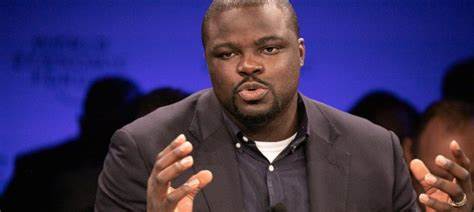
He adds that Future Africa is focused on supporting Africa’s young entrepreneurs with knowledge, infrastructure, finance, access to markets, skills and resources to help them work more effectively and succeed.
While Iyin developed the digital economy plan for the team of the then candidate of the All Progressives Congress (APC), now President Bola Tinubu, and worked closely with the President and his team, he says that he did not support any particular candidate during the country’s general elections.
Applauding the work being done by Nigeria’s Minister of Communications, Innovation & Digital Economy, Dr. Bosun Tijani, whom he calls his mentor, Iyin says the minister was the most prepared person for the role.
“In my mind, he has been preparing for this job for 10 years. I’m very glad that the President was very discerning, and in spite of the challenges associated with the role, decided to honour the ecosystem.”
Iyin adds that he has learned from several mentors throughout his life.
“I learned from so many people. I read widely. I have the benefits of being able to reach out to the best of Nigerian leadership. And I’ve been so inspired by so many of them over many, many, many years. If I even start naming mentors, we might not leave here tonight.”
His father is one of his biggest mentors. Growing up as a preacher’s son was interesting, he says, and he learned a lot about sacrifice, taking action, responsibility and leadership.
“I think the most important lesson that you learn is how to have a big heart. And I would say my father is a very exemplary leader in many respects. I’m very proud of my him and the work he’s done over the years.”
Prior to the current government, the tech entrepreneur had worked closely with the immediate past vice president, Prof. Yemi Osinbajo, SAN, who is now the Global Advisor for the Global Energy Alliance for People and Planet (GEAPP).
He describes Prof. Osinbajo as “an incredible visionary and inspirational human being”, adding that the former VP’s efforts gave a tremendous boost to and brought global investments into Nigeria’s tech space.
In his view, Osinbajo’s 2018 tour of Silicon Valley, US, was a catalyst that not only attracted millions of dollars in investments into Nigeria’s tech and innovation space, but continues to positively impact the growth of its ecosystem.
Speaking about Osinbajo, whom he said brought him into the National Industrial Policy and Competitiveness Advisory Council, Iyin said his US visit “was a huge milestone for us because it gave a lot of foreign investors the comfort to invest deeply in Nigeria.”
“Following that event, Y Combinator really started to double down on Nigerian companies. A lot of foreign investors got comfortable with Nigerian companies. Of course, the iDICE (Investment in Digital and Creative Enterprises) programme emanated from his office. There’s a lot of visionary work that Mr. Vice President did during this time.”
In 2022, Nigeria was said to have the highest number of tech startups in Africa, ahead of Kenya, South Africa and Morocco. Between January and August 2022, tech startups in Nigeria raised about $748 million, according to Statista
When Facebook Founder, Mark Zuckerberg, visited Nigeria in 2016, Iyin played a major role. In a recent interview, Bloomberg described him as the “Zuck of Nigeria”.
Iyin laughs again, but obviously relishes the ‘nice tag’, even though he thinks he “has a completely different reality from Mr. Zuckerberg.” He credits the Facebook founder for making some very important moves that shot Nigeria’s tech ecosystem into the stratosphere, including investing in Andela and visiting Nigeria.
“Mark Zuckerberg is perhaps my all-time favourite entrepreneur because of how visionary he is and how determined he is in the face of a lot of challenges and struggles, Actually, one of the things that inspired me to get into tech was watching The Social Network (movie).” he says, adding that Zuckerberg has a special place in his heart.
Obviously, the most important person that will always have the most special place in Iyin’s heart is his wife.
He says, “I’m married to one of the most amazing people in the world. At that time, I was getting married, I had become a person of means, which is always a dangerous time in a man’s life. So, I told God, ‘God, you need to send me the right person for me.’ She even keeps me busy. It’s been a joy.
“My wife is a storyteller, an Emmy and Webby award-winning producer. She’s a very accomplished woman in her own right,” he adds proudly. “I mean, she was actually into tech before me. She worked for GoPro, EA Sports. She was into e-gaming.”
In all, he says, he is wholly grateful to God for all of his life and career achievements.
“I really love the job, and the role I get to play as an active citizen, as a venture capitalist, as a father and husband. I’m a very, very lucky person; not lucky, but blessed actually. I’m very blessed and I’m very aware of that every day. And that is what spurs me to give even more back. Because I can’t imagine that God made a mistake by blessing me in this way.”
Widely travelled, he says Lagos, Nigeria’s commercial capital, is always home, no matter where he goes. “I love Lagos. I love the chaos, the fun, excitement and promise of Lagos.”
A firm believer in the Nigeria project, too, the tech entrepreneur says, “Nigeria is great. We just have to manifest it,” while highlighting its potential and that of Africa’s youth.
The United Nations says that Africa has the youngest population in the world, with 70% of sub-Saharan Africa under the age of 30. About 70% of Nigeria’s estimated 210 million population are under 30.
Highlighting the impact of Artificial Intelligence globally, Iyin says it will transform the tech and creative sectors. “AI is one of those things that would transform the world. I like to say that it probably would have as much of a transformative impact on the world as the Internet itself has had.”
However, he believes that AI should be moderated by humans in the loop to basically shape its credibility and creativity so that it delivers maximum results.
“There has to be somebody who moderates AI or initiates it. And I believe we as Africans have an opportunity to tap into it early, to be that person, that human on the loop.”
On the future of tech in Nigeria and Africa, ‘E’ acknowledges the growth in the sector, but is of the view that, “for the last 10 years, we’ve been running a demo, almost like God was preparing us to do something.”
“Now, we’re at a point of decision. If the ecosystem comes together and stops getting distracted by silliness all around, I think there’s an opportunity to build really robust businesses that solve real problems in the country.”
For someone who co-founded two unicorns and is now building a Future tech fund, that is worth taking note of.