

YOUNG, AFRICAN: The Nigerian Tech Whiz-kid Aiming to Make Positive Change Globally
A prominent US tech founder recently described him as a promising talent. Indeed. Oluwapelumi Dada says his goal is to use his tech knowledge and passion to build products that people love. He did his last two summer internships at two multibillion-dollar companies - Tesla Inc. and Dell Technologies. Some of his tech projects include an Artificial Intelligence (AI) system that can use one's computer to perform tasks and help drive operational efficiency in global teams. He’s now building a website called One Click Apply. In this first-ever and exclusive interview with ARUKAINO UMUKORO, the 19-year-old US-based Nigerian student says he wants build tech projects that will make a difference and create a lot of value for the world


Tell us a bit about yourself?
I’m 19, going on 20. I am from Oyo State, in Nigeria. I attended Rehoboth Peace Academy, Abuja) for my primary education (I think the school is closed now); Middle School (JSS 1-3) at Salem Academy, Abuja, and my Senior High School (SS1-3) was at the Government Science Secondary School, Abuja. I am currently studying Computer Science at the Huston-Tillotson University, Austin, Texas, US. I’m on a full tuition scholarship, but I worked as a Resident Assistant (which gives free housing).
What did you learn mostly from your summer internships at Telsa and Dell?
I did a three-month internship each with Tesla and Dell respectively. I did the Dell internship in 2022 and Tesla in 2023. I got offers for both companies for this summer, but I didn’t take it. On what I learnt during my internship there, I learnt how much culture is important in a company.
What is your current tech project, the One Click Apply, about?
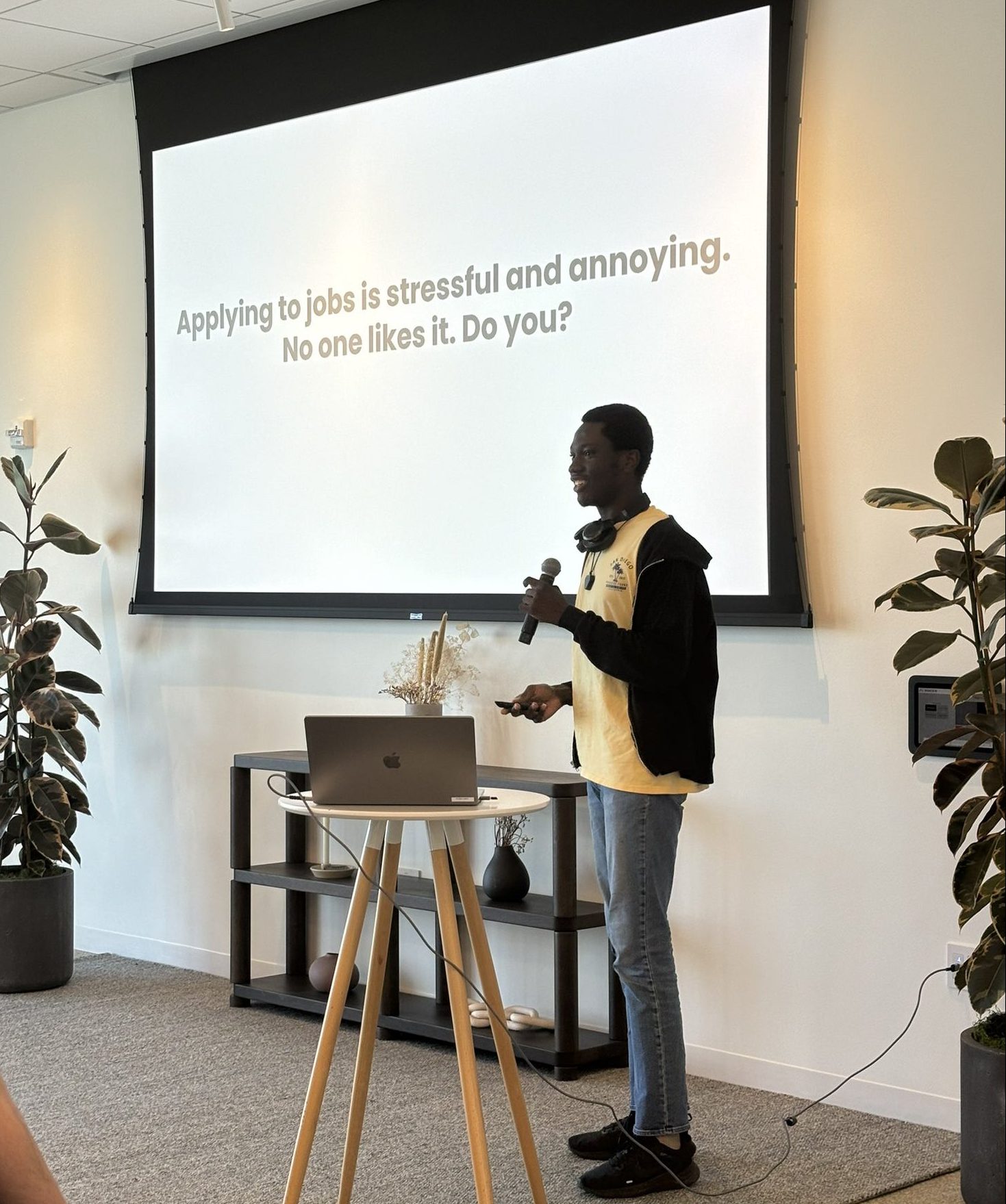
The One Click Apply is a website that allows students/job applicants apply to jobs in one click. We hope to make the job application process easier for students. Applying to jobs today is unnecessarily hard and One Click Apply helps job applicants not to worry about all the repetitive parts of applying for a job. Our end goal is to build the standard for applying to jobs on the internet, so that anyone anywhere won’t have to put in the same information on 10 different websites several times. We’re building a one click checkout for jobs.
What’s the inspiration behind this project?
I wrote a list of the most important things for students. So, I came up with “Academics, Jobs/Internships and Money and Girls/Boys”. I chose to work on Jobs/Internships because that’s where I thought I could build something useful and had an idea of what to do. I also did not have any good ideas for helping with “Money and Girls/Boys.” I had also been playing with AI (Artificial Intelligence) using computers last year, so I just built it.
Who is your biggest inspiration outside the tech space?
My parents have been a huge inspiration for me. Also, I’ve had a Bible Club Lead that really taught me a lot of things when I was a kid. I call him Uncle Emma (@princeleun). He created a Bible Club 15 years ago that I’m a part of. The club, called the Catch Them Young Bible Club, really impacted my life positively. He also taught me how to fix and sell computers.
Did you always know that you wanted to pursue tech or something else as a career?
Interestingly, I loved animals and wanted to be a veterinary doctor. I only chose (to study) Computer Science when I came to the US because my scholarship allowed me to choose between Business or Computer Science. I chose Computer Science and learned python the week I landed in the US.
But I got to know about tech at a young age. So, I could say I was always into tech. My mum (Mrs. Temitayo Kehinde Dada) brought in a computer when we were very young, so I naturally got an aptitude for computers. I can do a lot of things on it. My dad (Mr. Kehinde Dada) was a graphic designer, so I learned some graphic design from him. I also did some graphic design with photoshop and Corel Draw when I was much younger. I started coding late, however. I learned Java when I was 11, but only for that summer. I stopped coding when I started secondary (high) school, but when I got into SS2 (11th grade) I started making websites with Wix, and learning HTML when I graduated (from secondary school).
What summer coding class was that?
The summer coding class was my parents paying one of my older cousins, who was studying software engineering at university, to teach me.
What would you tell parents with children who are interested in learning coding?
Parents should fund their children’s passions and interests. Buy him a good laptop, provide a good Internet facility, ask him what he’s working on and talk about it with him. The little things really do matter; listen to his interests and fund them. Kids choose what they want to do, but you have to guide them, and provide different options, see what they tilt towards and then fund what they like so they can become super good at it.
For those young kids, I would tell them: there’s so much you can do, wherever you think you are at, keep trying to get better. No matter how hard things look, they are usually not that hard in practice. Build a lot of fun projects, websites that do different things, apps etc.
What about some less privileged, but smart kids with passion for tech, whose parents are not financially buoyant to fund such…
One of my friends started coding on his phone. This may not be optimal, but you can learn a lot (from doing it).
How does being a Nigerian help spur your desire to achieve something great?
I think being Nigerian teaches you to be tough and gives you some sense of pride. Nigerians think they are better than everyone. So, I grew up in that kind of environment. Also, Nigeria has a very competitive academic system, and that has helped me to become more competitive generally.
What’s your advice to young Nigerians and Africans who may feel frustrated about their environment and circumstances?
I would say, be proactive: less complaining more building. You can be whatever you want, you just have to do it. I’ll also add this: There’s always something to complain about. There’s always something not going right, but you cannot let that stop you. Here’s a quote from Richard Hamming that has really helped me in the way I think about this: “What appears to be a fault, often, by a change of viewpoint, turns out to be one of the greatest assets you can have.” Use your problems to your advantage! It may sound counterintuitive, but it’s really useful.
Who are some of the great people you’ve met so far (home and abroad) and how have they inspired you?
I’ve met quite a few people, such as Sam Parr (Internet entrepreneur and tech investor) @thesamparr, Adewale Yusuf (AltSchool Africa), Opeyemi Awoyemi (founder of Jobberman Nigeria and Whogohost Limited), and Hubert Thieblot (Founder of Internet company acquired by Twitch).
Were you nervous meeting Sam Parr in the US and pitching your tech idea to him recently?
Yes, I was a little bit nervous, but I succeeded in making him understand what I was working on. After I met Sam, I got to meet several other cool people and builders and made some new friends. I incorporated and raised money so I can continue working on one click apply over the summer.
How much have you raised so far?
I would not rather not share how much I raised.
What are your goals in the next five to 10 years?
To completely reinvent what recruiting looks like. Recruiting today is broken and is desperately begging to be fixed. In terms of recruitment, finding applicants is hard for companies and employers. So, there’s a lot of work to be done in making the experience easier on both the employers and applicants. For my life goals, I want to build really cool stuff and create a lot of value for the world.