


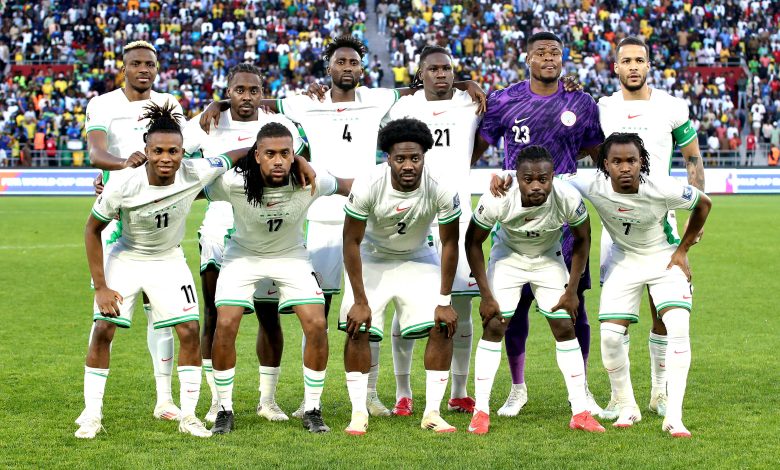
Eric Chelle has named separate Super Eagles squads for the upcoming Unity Cup invitational tournament in London and high-profile international friendlies against Poland and Portugal next month.
The squads feature a blend of established stars, home-based talents and first-time invitees.
The Nigeria coach released a 27-man squad for the 2026 Unity Cup mini-tournament and a separate 24-man list for the European friendlies, as preparations continue ahead of next year’s Africa Cup of Nations campaign.
For the Unity Cup tournament scheduled to hold between May 26 and 30 at Charlton Athletic’s Valley Stadium in London, Chelle retained key players including captain Wilfred Ndidi, Moses Simon, Terem Moffi and Akor Adams.
Nigeria will face Zimbabwe in the semi-final on May 26, with the winner advancing to the final against either Jamaica or India.
The squad also includes several new faces, among them goalkeeper Arthur Okonkwo, defenders Emmanuel Fernandez and Igoh Ogbu, midfielders Tochukwu Nnadi and Ebenezer Akinsanmiro, and forward Rafiu Durosinmi.
Chelle also handed opportunities to a number of Nigeria Premier Football League players, including goalkeeper Michael Atata and midfielders Aderemi Adeoye, Ayobami Junior and Tosin Oyedokun.
For the June friendlies against Poland and Portugal, the coach recalled several senior internationals, including Victor Osimhen, Ademola Lookman and Alex Iwobi.
Defenders Calvin Bassey and Semi Ajayi, midfielders Frank Onyeka and Alhassan Yusuf, as well as forwards Paul Onuachu and Samuel Chukwueze, were also included.
The Super Eagles will play Poland at the PGE Narodowy Stadium in Warsaw on June 3 before travelling to Portugal for another friendly on June 10 at the Estádio Dr. Magalhães Pessoa in Leiria.
The Portugal match is expected to provide one of Nigeria’s toughest tests under Chelle so far, with the European side using the fixture as part of preparations for the 2026 FIFA World Cup.
The latest squad announcement comes as Nigeria intensifies preparations for the next Africa Cup of Nations, where the three-time African champions have been drawn alongside Madagascar, Tanzania and Guinea-Bissau.
Observers say the squad selections reflect Chelle’s attempt to balance continuity with experimentation, particularly through the inclusion of younger and home-based players alongside experienced internationals competing across Europe.
The Unity Cup squad, in particular, is expected to provide opportunities for emerging players to stake claims for regular places in the national team setup ahead of the AFCON qualifiers and future World Cup preparations.
Nigeria won the Unity Cup last year, with captain Moses Simon lifting the trophy following victory at Brentford Stadium.
24-man Super Eagles list for Poland, Portugal friendly matches
Goalkeepers: Maduka Okoye (Udinese FC, Italy); Arthur Okonkwo (Wrexham FC, England); Francis Uzoho (Omonia FC, Cyprus)
Defenders: Oluwasemilogo Ajayi (Hull City, England); Calvin Bassey (Fulham FC, England); Bright Osayi-Samuel (Birmingham City, England); Bruno Onyemaechi (Olympiakos, Greece); Zaidu Sanusi (FC Porto, Portugal); Igoh Ogbu (Slavia Prague, Czech Republic); Emmanuel Fernandez (Glasgow Rangers, Scotland)
Midfielders: Alex Iwobi (Fulham FC, England); Frank Onyeka (Coventry FC, England); Wilfred Ndidi (Besiktas FC, Turkey); Raphael Onyedika (Club Brugge, Belgium); Fisayo Dele-Bashiru (SS Lazio, Italy); Tochukwu Nnadi (Olympic Marseille, France); Alhassan Yusuf (New England Revolution, USA)
Forwards: Ademola Lookman (Atletico Madrid, Spain); Samuel Chukwueze (Fulham FC, England); Moses Simon (Paris FC, France); Paul Onuachu (Trabzonspor AS, Turkey); Akor Adams (Sevilla FC, Spain); Victor Osimhen (Galatasaray FC, Turkey); Terem Moffi (FC Porto, Portugal)