


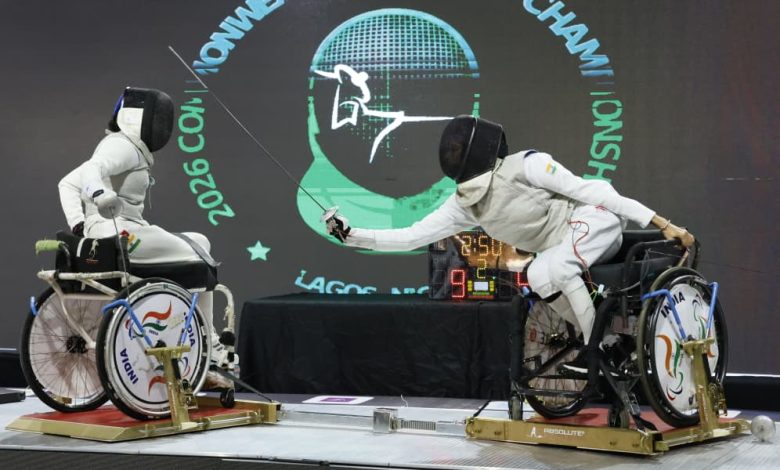
Heading into the final day of the 2026 Commonwealth Fencing Championships in Lagos, India holds a commanding lead on the medal table — as wheelchair fencing makes its debut as a full medal event in what has already been a historic week for the sport in Africa.
With most events now decided, India has established a commanding lead on the medal table with 17 gold medals, 13 silver and 13 bronze. England follows in second place with two golds, two silvers and nine bronzes, while host nation Nigeria and Cyprus complete the top four.
India’s dominance has been evident across all three weapons — épée, sabre and foil — with its men’s and women’s teams repeatedly reaching the podium. The country has also made its presence felt in the newly introduced wheelchair fencing events, adding further medals to an already impressive tally.
Nigeria’s gold came from 17-year-old Oghenegaren Osievwo-Thompson, whose breakthrough victory in the men’s Under-23 épée earlier in the championships gave the home crowd one of the tournament’s defining moments. His historic triumph delivered Nigeria’s first-ever international fencing gold and has provided a major boost for the development of the sport in the country.
Nigeria has continued to add to its medal haul, with top-rated Oluwafolayemi Akinyosoye securing bronze in the men’s sabre. The country’s wheelchair fencing team has also enjoyed a remarkable campaign, contributing two silver and eight bronze medals to Nigeria’s tally and making this the country’s best outing yet at the Commonwealth Fencing Championships.
Australia has also featured among the leading medal-winning nations, with two silver and three bronze medals, while South Africa has secured two silver and one bronze. Northern Ireland and Wales have each claimed a bronze medal. Cyprus, represented by a single athlete, has also secured a gold medal, ensuring its place among the tournament’s leading medal-winning nations.
But beyond the medal table, one of the most significant moments in Lagos has been the introduction of wheelchair fencing as a full medal event. Its elevation from a demonstration sport at the 2022 Commonwealth Fencing Championships in London to a competitive medal discipline in Lagos has opened a new pathway for athletes with disabilities on the Commonwealth stage.
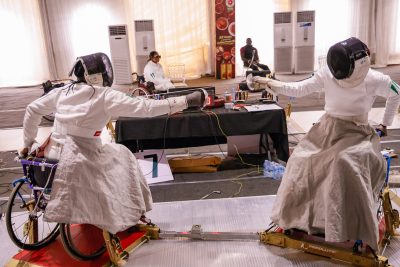
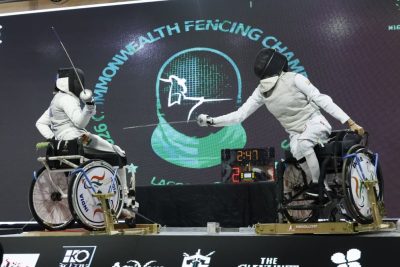
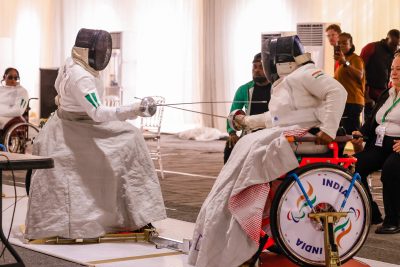
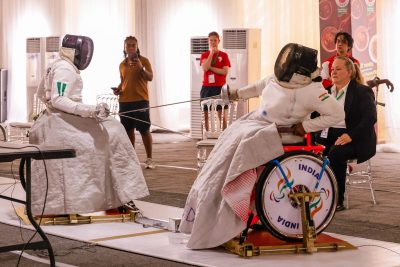
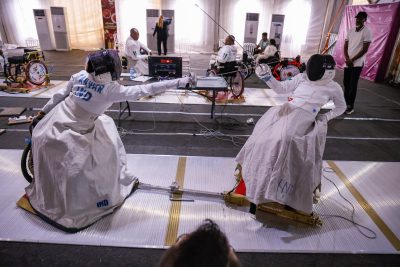
Nigeria, the host nation, entered the championships with a 12-member team comprising six men and six women, competing against established fencing nations including India, England, Australia and South Africa. The country’s participation is part of a broader effort by the Nigeria Fencing Federation to expand the sport’s reach and create opportunities for young Nigerians to compete at an international level.
Athletes and delegations have also praised the organisation of the Lagos championships, with competitors from South Africa, England, Australia and India highlighting the efficiency of the Local Organising Committee, particularly in accreditation and logistics.
For England’s women’s sabre gold medallist Bethany Brierley, the experience has extended beyond competition.
“I am enjoying myself in Lagos because the environment is inspiring and the people are very friendly,” Brierley said. “The enthusiasm of the young Nigerian fencers shows they are working hard to raise the profile of the sport as a developing nation.”
Her comments capture one of the broader ambitions behind Lagos 2026: to use an international championship not only to determine medal winners, but also to expose African athletes to higher levels of competition and demonstrate that fencing can develop beyond its traditional strongholds.
This is also a vital opportunity to market Lagos as a destination for international sporting events, enhancing the city’s tourism value while showcasing its reputation for hospitality.
That ambition has already been given a powerful boost by Nigeria’s historic gold, the country’s impressive wheelchair fencing performance and the strong reception the championships have received from visiting athletes and delegations.
As competition moves into its final day in Lagos, the championships are becoming more than the first Commonwealth fencing event staged in Africa. They are increasingly serving as a platform for a wider conversation about access, inclusion and the future of fencing on the continent.
For a sport still seeking a broader foothold in Africa, every bout on the Lagos piste is beginning to look like part of a much larger story.
India has dominated the medal table and set the competitive standard, but Nigeria’s historic achievements and the inclusion of wheelchair fencing have ensured that Lagos 2026 will be remembered for more than the medals alone. With one day left, the final bouts will bring the championships to a close, but the impact of what has taken place on the Lagos piste could last considerably longer.