



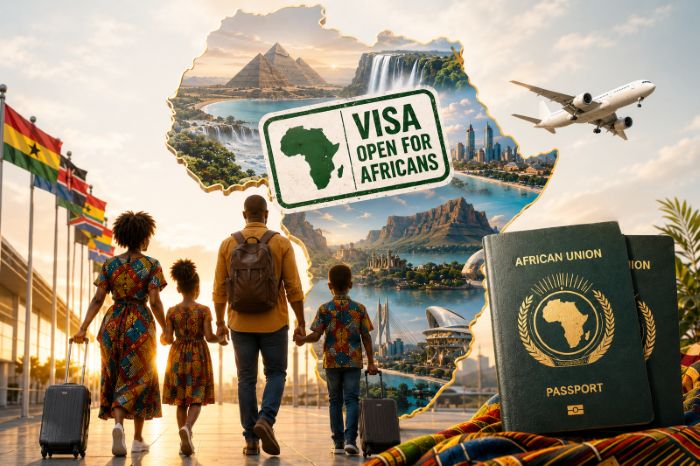
Imagine a future where travellers can move seamlessly between Lagos, Accra, Kigali, Nairobi, Dakar, Cape Town, Zanzibar, Cairo, and Casablanca with minimal restrictions.
Africa possesses some of the world’s richest tourism assets, yet one major obstacle continues to limit the continent’s full potential: Africans still struggle to move freely across Africa.
Yet that future is imaginable. Many African countries market themselves independently without connecting their stories to a broader continental experience. Africa’s greatest tourism advantage may lie precisely in its shared cultural connections; the threads that already bind its people across borders.
Across West Africa alone, communities in Nigeria, Benin, Ghana, and Togo share language, cuisine, traditions, spirituality, and historical ties. Similar cultural overlaps exist across East, Central, and Southern Africa. The borders inherited from colonialism frequently divide people who already possess deep historical and cultural connections. Visa openness is, in part, an attempt to reconnect these realities – and to help Africans rediscover Africa.
For decades, African governments have spoken passionately about integration, Pan-Africanism, economic cooperation, and regional trade. Yet despite these ambitions, travelling from one African country to another often remains more difficult, expensive, and bureaucratic than travelling outside the continent altogether. Travellers face lengthy visa processes, high fees, inconsistent immigration policies, and bureaucratic hurdles that continue to discourage Africans from exploring neighbouring countries.
This paradox – a continent bound by shared history yet divided by its own borders – remains a major obstacle to seamless mobility, economic integration and Africa’s ability to reposition and reconstruct its narrative within the global worldview.
Recently, however, signs of change have begun to emerge. Togo announced visa-free access for African passport holders for stays of up to 30 days, becoming one of the latest countries to embrace this policy direction. Ghana’s President John Dramani Mahama also announced a visa-free policy for Africans beginning on May 25, 2026, alongside a new electronic visa system designed to simplify travel while maintaining security checks.
These countries join a growing list of African nations moving towards greater openness. Rwanda has long maintained one of Africa’s most progressive visa-on-arrival policies for African citizens. Kenya has also introduced measures towards visa-free travel, while Seychelles, Benin, and The Gambia have taken similar steps encouraging freer movement across the continent.
These decisions are not isolated acts. They reflect a broader continental push aligned with the African Union’s Agenda 2063, which envisions a more integrated Africa built on seamless mobility, trade, and economic cooperation. Yet the movement remains limited in scope. According to available data, only six of Africa’s 54 countries have fully embraced visa-free policies for fellow Africans.
The implications, however, extend well beyond those six. It invites comparisons with Europe’s Schengen visa system, widely regarded as one of the most successful examples of regional integration in modern history.
The Schengen system allows travellers to move freely across 27 European countries using a single visa, transforming Europe into one of the world’s most visited and economically integrated regions. Tourism, trade, and labour mobility flourished under this arrangement, strengthening interconnected economies and encouraging cultural exchange.
Africa’s approach differs significantly. Rather than operating under a unified continental framework, individual African countries are independently easing restrictions. While this creates uneven coverage, it lays the groundwork for a future African visa regime. The African Union has already proposed an “African passport” that would eventually allow unrestricted travel across member states.
This wave of visa openness represents more than immigration reform; it is a deliberate strategy to dismantle long-standing barriers to African unity, and tourism stands to benefit enormously.
Africa’s tourism industry has historically relied heavily on visitors from Europe, Asia, and North America. Yet the continent itself is home to a vast, untapped market of potential travellers. Visa-free policies encourage Africans to explore their own continent, creating new opportunities for airlines, hotels, restaurants, tour operators, cultural festivals, and local economies.
A Ghanaian family can now plan a holiday in Togo without worrying about visa delays. A Rwandan entrepreneur can attend a conference in Accra with minimal paperwork. These conveniences create consequences that extend across the tourism and hospitality value chain.
Togo is positioning itself as a regional hub for culture and services. By removing visa barriers, it hopes to attract more visitors to its festivals, beaches, and historic sites. Ghana, with its rich cultural heritage and vibrant tourism sector, is equally positioned to benefit from increased intra-African travel.
Beyond tourism, visa openness fosters trade and investment. Business travellers can move more freely, exploring opportunities under the African Continental Free Trade Area (AfCFTA). Cross-border trade fairs, exhibitions, conferences, and investment summits become easier to organise, strengthening regional economies and encouraging entrepreneurship.
Culturally, the policy enhances people-to-people connections. Africans can attend weddings, cultural festivals, sporting events, and educational exchanges across borders without unnecessary bureaucratic obstacles. This strengthens Pan-African identity and deepens solidarity among nations.
Industry leaders are increasingly connecting visa openness to Africa’s tourism future. Speaking at the recently concluded Africa Legacy Summit at Eko Hotels & Suites in Lagos, Danny Kioupoureglou, General Manager of Eko Hotels & Suites, noted that breaking down travel barriers would significantly strengthen intra-African tourism and hospitality growth.
“Breaking down the barriers between countries will help intra-Africa travel and also the growth and development of the hospitality and tourism industries,” he said. “It is a must and it has to happen.”
His comments align closely with the broader aspirations of AfCFTA, where the freer movement of people complements the freer movement of goods and services.
Iyadunni Gbadebo emphasised the importance of indigenous African enterprises in shaping the future of hospitality and tourism on the continent. She described African-owned institutions as symbols of resilience, continuity, and cultural pride capable of thriving within a more open continental market.
Drawing on the Afro-Caribbean perspective, Crystal Cummings, Executive Director of Africa Caribbean Initiatives, drew parallels with the Caribbean’s CARICOM model, where easier regional movement has strengthened tourism economies and cultural exchange among island states.
“In the Caribbean, easy movement promotes tourism across islands,” she explained. “Africa should do the same – sell and showcase culture to each other for exchange. There’s more in common than not among African countries.”
Her emphasis on collaboration rather than competition highlights the case for regional tourism circuits, where neighbouring countries can jointly market shared heritage, history, and cultural experiences to African travellers.
Despite the growing momentum, significant challenges remain. Only a handful of African countries currently offer full visa-free access to fellow Africans. Security concerns require governments to balance openness with effective border management and regional security cooperation.
Infrastructure presents another major challenge. Increased tourism demands substantial investment in airports, roads, rail systems, hotels, and digital infrastructure. Without adequate facilities, countries risk frustrating travellers rather than attracting them.
Political will is equally essential. Visa openness must be accompanied by broader reforms in customs administration, immigration systems, regional transportation, and intergovernmental cooperation. Without sustained commitment, the movement risks stalling before meaningful continental integration is achieved.
Yet despite these challenges, the momentum remains undeniable. The recent decisions by Ghana and Togo reflect a growing recognition that Africa’s future lies in greater unity rather than continued fragmentation. By making it easier for Africans to travel within Africa, these countries are unlocking new possibilities for tourism, trade, investment, and cultural exchange.
If more African nations follow this path, the continent could eventually develop its own version of the Schengen model and create a truly interconnected African tourism and mobility ecosystem. Whether that vision is realised depends on the political will of governments, the investment of the private sector, and the shared responsibilities of Africans on the continent. Tourism, more than any other sector, stands to reap the earliest and greatest rewards of a borderless Africa.