

Njideka Akunyili-Crosby: The Nigerian Artist Behind Barack and Michelle Obama’s New Portrait
In this exclusive, first published in 2015, dig into our interview with this brilliant artist, who Victor Ehikhamenor describes as the “Chimamanda of the Art World.”


Nigerian-born, US-based artist Njideka Akunyili-Crosby has been described by CNN as one of “New York’s most promising new talents.” In pop culture parlance, Njideka is the next big thing in the art world. I had sought an interview with her in February 2013, but it didn’t work out. So when Victor Ehikhamenor – an award-winning visual artist and writer who was in town for Frieze Art Fair Week and the 1:54 African Art Fair – invited me to Tafeta Gallery in Central London, I was thrilled to finally meet Njideka there. An interview appointment was fixed for the next day. A Yale University MFA graduate, she had already sold out her works at the 2012 Art Basel, the world’s leading fair for modern and contemporary art. She has also completed a year-long residency at the prestigious Studio Museum in Harlem, New York. Here is our exclusive interview with this brilliant artist, who Victor Ehikhamenor describes as the “Chimamanda of the Art World.”
Africa Interviews: You left Nigeria at 16 and wanted to become a doctor. When did you decide to become an artist?
Njideka Akunyili-Crosby: It was a smooth transition, and I still ended up graduating with a Biology major. I took my first art class in the second semester of my first year, and after that I took one or two art classes every semester, so I ended up as a double major.
Majoring in Art wasn’t really a choice; it was more that I had taken enough classes that I could major in it, so I might as well. After I graduated, I took the year off and went back to Nigeria to do the compulsory National Youth Service Corps, and that was my year to really think and make a decision. That was my crossroads moment, and I knew I could go either way, and it was a lot of weighing up where I wanted to go.
I loved doing art more; it didn’t seem like work when I was doing it. When you do what you love, it would never feel like work. That choice felt more relevant, more important, like there was more of a stake to it than doing medicine. Of course, I don’t want to go into a “medicine-bashing” thing – I was very sick in grad school and doctors saved my life, so medicine is fantastic.
Africa Interviews: Why was it a defining moment for you?
Njideka Akunyili-Crosby: For me, just talking about feeling the urgency to do art or feeling like this seems important right now goes back to the conversation we had earlier on about how it’s hard to want to do the things you can’t see.
The first time I really thought I could be an artist was through my professor in undergrad. For me, seeing an artist who was living as an artist, teaching art classes, very happy with his life, content, smart, engaged with his work, and making very compelling, interesting work, was something I wasn’t aware of.
Of course, there had been very interesting artists working in Nigeria for years – the Nsukka Group, including El Anatsui – but I wasn’t privy to that world, and a lot of people were not, and are not. So, in my mind, art wasn’t something visible; my vision of an artist wasn’t the reality of it. I also felt that there were many people doing non-conventional things. It was at a time when I was hearing of more people going into the creative field, more people choosing to pursue music, to pursue dance, and art, and curating, and writing, and fashion, and event planning – things I never heard of when I was young.
When I was young, nobody would say, “What do you want to do?” and hear, “I want to be an event planner.” The answers were very rigid, and then there were all these people challenging what had been the norm for a time. And I felt like I wanted to be part of that exciting change, so that’s part of why I made that decision.
Africa Interviews: Did your parents at any time oppose your choice of career?
Njideka Akunyili-Crosby: They didn’t oppose it, but I think they questioned it, and I don’t think that’s a bad thing. I actually think it’s important. When I have kids, it will be okay for me to question the choices they make, especially if it’s something that isn’t a part of my world, or something I have no idea about. So I’m worrying that this is not a feasible thing.
When parents challenge, it comes from a place of love. And I remember reading something once. There was a guy who gave a graduation speech, and he was giving life lessons. I stopped for a second because it wasn’t one of the clichés; it was something I had never heard before. And it was: your parents don’t always want what’s best for you -or it’s something like your parents don’t want what’s best for you. And that made you stop, like, why won’t they want what’s best for you? And then the next sentence was that they want what is safe for you, or something like that.
So it just explains why parents are worried, because parents go before the kids, and I think they want to know that when they leave, you won’t suffer; you’ll be comfortable. And that is why parents push for safe things. Like with medicine, they are sure you will get a job and you won’t suffer. With art, it’s very unpredictable, and that’s where the challenge comes from. They push because they want to be sure you’ve thought about it, and you’re invested in it enough to be okay with it when it doesn’t work out and you’re not doing well. it was good to have that challenge from them.
Africa Interviews: There’s a lot of family in your drawings and paintings. How does this personal narrative influence your visual storytelling?
Njideka Akunyili-Crosby: I relate that to when writers say, “Write what you know.” So, for me, it is “paint what you know.” There is a lot of intimacy in my work – it’s very central, very intimate. I want you to feel that. For me, it’s about maybe enveloping someone into a domestic space. So, for me, there’s a wealth there.
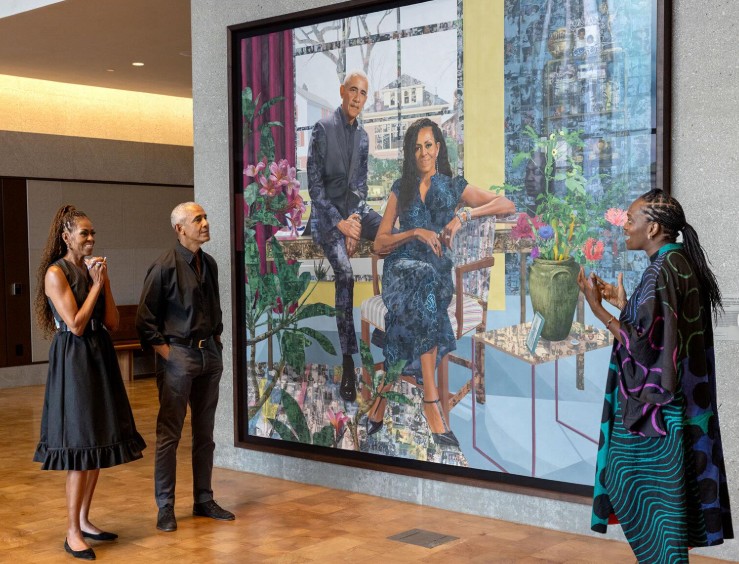
For me, intimacy has to come across; it has to be sincere. It’s hard for me to make an intimate work if I’m making images of people I don’t know or care about. Making images of people I know and love, and have known for years, and grew up with, helps push that for me, and it really goes back to what I am doing.
A lot of it is trying to put my finger on the Nigeria I grew up in. Thinking of Nigeria in the mid-1980s, early 1990s, I’m thinking of the change from that to the Nigeria of now, and it makes sense to do it through the lens of me because I lived in it, and the other people who lived in it with me, like my siblings.
Africa Interviews: Your work captures intimate and sensual situations. What role does your husband play in this creative process?
Njideka Akunyili-Crosby: (Laughs) He is quite involved in the work. He has a really good eye; he’s a very good critic, and I run a lot of things by him. A lot of artists do it. A lot of times, we have studio visits, and we have critics coming in, and they give you feedback because you’re in this little room by yourself for hours every day making work. After a point, you don’t see the work anymore. You’re so close to it. It’s the same way a writer will give a friend or an editor a manuscript to read, and they come back and they give you feedback.
So I will text him pictures of things in progress, and he will give me feedback: “No, take that green out,” “That orange doesn’t match that.” So he’s very helpful there. But his aesthetic is very different from mine. When we started dating, or when I first started doing art, a lot of my colours were very limited. I did a lot of brown-based paintings, and he’s a very colourful person. It sounds weird, but he loves a lot of colours. He is very into urban culture and street art, and just the influence of street art and things like that. So he’s very into bright oranges, turquoise, and through being with him, I’ve started buying into that urban aesthetic, and my colours have become brighter and bolder. So it’s nice to have him to play off.
Africa Interviews: Do your loyalties to Nigeria and your American husband create a contradiction in your work, and how?
Njideka Akunyili-Crosby: Somewhat…
Africa Interviews: How?
Njideka Akunyili-Crosby: I think what it is, is negotiating both, finding the in-between space, or the space where I can straddle both cultures. And it’s a story of contemporary Africans, especially people of my generation, who are a lot and are scattered throughout the globe, in the UK, in America. Nigerians are everywhere, in Cuba, in India. How do we maintain our identity as proud Nigerians, but also integrate into the new society we find ourselves in, to create this new hybrid identity for ourselves?
There is this Ghanaian cultural critic who wrote a beautiful essay on “cosmopolitanism,” and his whole thesis is that cosmopolitanism is actually not about a melting pot. People think it’s about all these cultures coming together and melting to be one thing, whereas it is more about difference and maintaining those differences, but next to each other. That’s what I’m fascinated by.
And it’s the story of contemporary cosmopolitan Africans. How do you exist as a Nigerian in America, or a Nigerian in the UK, or a Kenyan in South Africa? Just as the world is globalising and all these movements are happening, there are more and more people in those situations, and my work exists within that.
So, just thinking of myself as a Nigerian and also an American – through me having American citizenship, but also with my marriage – which has further rooted me in the country, how do these two differences exist alongside each other? I’m trying to explore that with the work.
Africa Interviews: Literature coming out of Nigeria and Africa plays a major role in your work. Can you name the writers that have influenced you?
Njideka Akunyili-Crosby: Definitely Chinua Achebe and Chimamanda Adichie. But then, of course, there are other people. I was just talking to someone recently about a book I had heard a lot about growing up but didn’t read till recently, “Nervous Conditions” by Tsitsi Dangarembga. It was fantastic. But, I mean, with Achebe, Achebe just opened the doors for so many people, not just writers.
There is a Nigerian curator, Okwui Enwezor, who talks about Chinua Achebe as being important to him because he does a lot of promotion of artists of African descent. And I know he gets a lot of people questioning that, like: “Why are you always working with Africans? Why is it always about people of Africa?” and all that.
I went for a lecture he gave once, and he said nobody ever asks that of somebody doing work on, say, Andy Warhol. There are people who devote their lives to just one artist, but they give him a hard time for his focus being on Africa. He brought up Achebe, and he talked about this urgency again, where there is just this void, and that created more of an urgency for him to focus on it. Nobody is doing it, and if he doesn’t do it, who will? And it just seems relevant for him. So Achebe did that for everyone.
Even Chimamanda’s very popular and fantastic “The Danger of a Single Story” speaks to something that was very dear to Achebe; his insistence on us telling our own stories. Otherwise, other people would tell them for us, and they would become a single story. The more people who tell their side, the more a person, place, culture, group, or country becomes multidimensional, rather than being reduced to a single facet while all the other parts are ignored. Writers are doing that. I’d like to think all the other creative people are doing it.
The attention that is coming to the Nigerian fashion industry introduces a different part of the country to the rest of the world. With the interest that comes to Nigeria, the complexity of Nigeria begins to materialise. So that’s why I feel connected with literature. I feel like even though we are all doing different things, there is a connection in terms of what we are doing.
But also, this is something I’ve talked about before. Something that draws me to literature is this borrowing of something, like borrowing a tradition from somewhere. So when I think of Chinua Achebe writing in this language (English) that isn’t his, or wasn’t his – he inherited it – but he was able to take that language and use it to talk about the experience of a place the language is not from.
And I think the way he was able to do it actually has to do with things he was doing in terms of structure and formal decisions he was making with the language to make that happen. Achebe has a quote that I love, but it’s Achebe quoting Baldwin. He said: “English, when altered, can be made to bear the weight of my African experience.”
I really love that because I feel the parallel I see is taking my art training, which was in America, at the Pennsylvania Academy, which is very rigid. It’s an academy. It’s like: how do I take this tradition that I’ve now inherited and use it to talk about a place that this tradition is not linked to? How do I alter it to make it bear the burden of this other experience? That’s where the experimenting and collage and all those things come from. Like, how do I break it open and make it do something else, while it is also still evident where the tradition comes from?
Africa Interviews: Why do you combine different materials in your work?
Njideka Akunyili-Crosby: That’s one. The other one is I also combine different materials because it’s very interesting when work is made in such a way. Something which I enjoy seeing is when the formal decisions actually prop up the content of the work, where those choices parallel the content. For me, I wanted that to happen in the works.
If I wanted to make work about all these differences existing side by side – that is the crux of it, and one of the big umbrellas that hold the work together – I want to have the way I put the work together parallel that, or state that. So, I’m using different languages of image-making, from photography to printmaking, drawing, painting, to collage, and having those exist side by side.
But I’m thinking of a way for them to exist side by side in a seemingly harmonious way because there is a tension to it, but it is held together. That’s why the multi-medium work process is important to me. Also, it’s so that when the viewer looks at it and their eyes are scanning the work, there are these immediate jumps that are happening.
You’re looking at an area that is a flat shape of colour, and then you shift and you are looking at a place that is painted in a detailed academic style, and then you are looking at a photograph of Nigeria; at something painted very loosely, or something layered, or the furniture from my New York apartment. Then you move again and see something else.
So as you move through it, your eyes are actually taking these jumps between worlds. It is in terms of jumps between time, in terms of painting references, but also in terms of the photograph. You are making jumps in place, in terms of the continent and culture. I’m very interested in all these sides, these differences. Looking at it in various layers, but it’s always about difference next to difference, and the jumps you make between those.
Africa Interviews: Looking at your creative process, what would you say is the most difficult part?
Njideka Akunyili-Crosby: The beginning. You obviously don’t want to repeat yourself. You’re having to come up with something new. It’s like your work is one long continuous conversation, so you don’t want to repeat yourself, but you can also still have a conversation from the last few works you did.
It’s complicated because it’s like you have this quest you’re on, and you never quite feel you’ve found it, because once you have, you are done. You’re like that dog: you are digging and digging. It’s the same area you are digging in, but it has to be different. So, that’s the first thing: figuring out what.
The other side is multi-faceted. With each piece, I’m looking at a different facet of a convoluted shape. So, it’s like, where do I scan next? Different pieces focus on different things, but then also, just something simple, like what is the image I want to do next? Do I want to do a group scene? Do I want a single person? Two people? Is it inside? That takes a lot of time, and that isn’t immediately apparent in the work because all of those decisions require research. So, when I go on, the next two weeks might just be research. For interiors – where do I want it to be?
I might bring out all my family albums, go through them all, take photographs, find things on the internet, and have a wall filled with pictures. Let’s say I want a living room scene. Where do I want them? Do I want them in a corner? Do I want them straight up? What kind of chairs do I want? What kind of lamp? What kind of table? So it’s a lot of that. The next step is the composition. I could go on forever – the point of view, the lighting of it. Once that’s settled, and I have my image and the drawing, then the next step is the value study, just how the dark and light move through the piece.
Editor’s note: This interview was first published on January 5, 2015.